
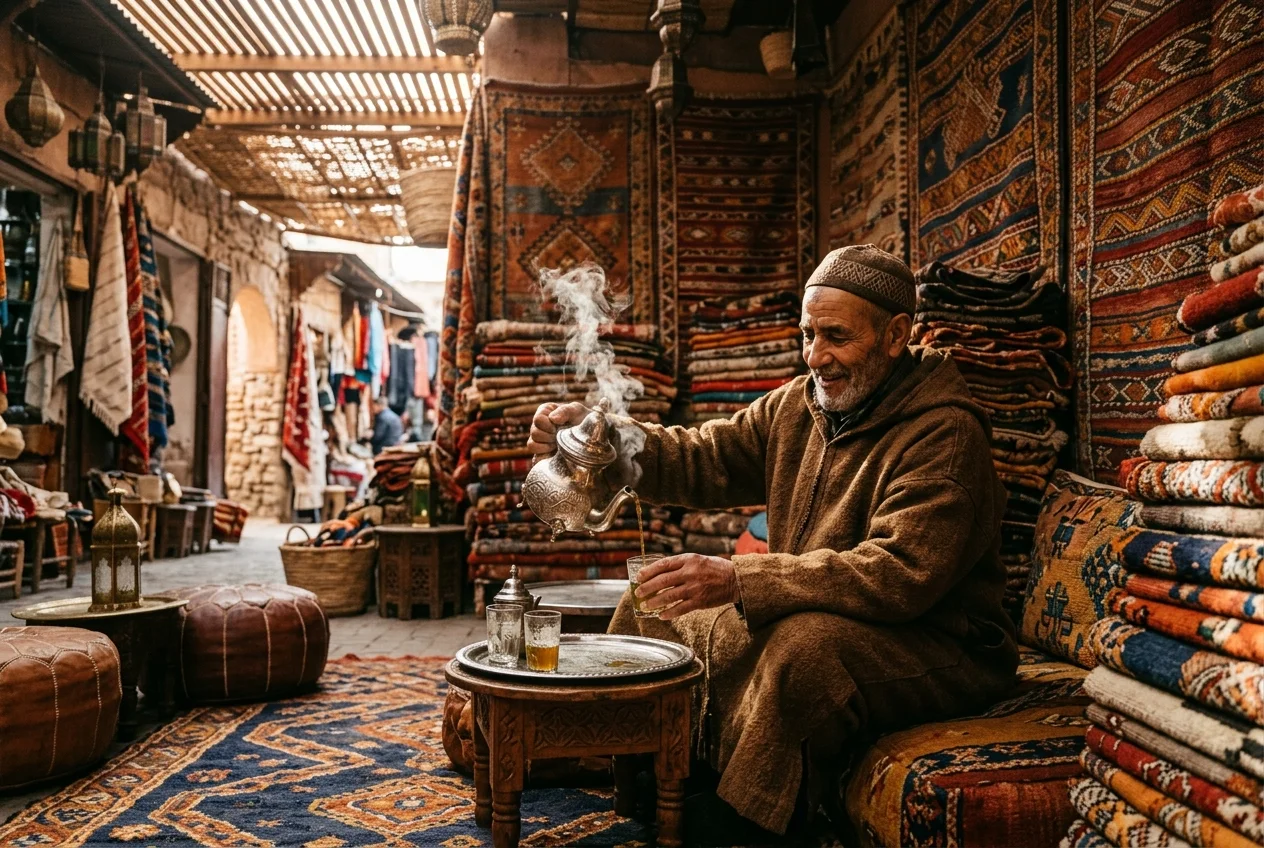
Most Western guidebooks treat the Marrakech souk like a gladiatorial arena. They tell you to brace for battle, cut the merchant’s first asking price in half with a cold stare, and walk away aggressively to prove you cannot be conned. They turn what should be the most intimate, sensory, and human experience in North Africa into an exhausting exercise in defensive paranoia.
They are completely, tragically wrong.
In Morocco, bargaining is not combat. It is an ancient social contract, an unhurried ritual of acquaintance, hospitality, and mutual dignity that predates cash registers by a thousand years. When you enter a carpet alcove or a brass workshop in the medina, you are stepping across a domestic threshold. If you understand the rules of the room, you will not only secure a fair price for extraordinary craftwork—you will walk away with a friendship and a deeper understanding of the country than any palace museum can provide.
1. The Morning Whisper: Before the Tour Buses Arrive
If you want to understand the soul of the medina, you must visit Rahba Kedima (the Spice Square) at eight-fifteen in the morning.
The sun has just cleared the clay parapets of the Ben Youssef Madrasa, slanting down in dusty golden shafts through the slatted reed roofs. The day-trippers from the big five-star golf resorts are still having continental breakfast by their pools. In the souk, the only sounds are the sharp clatter of corrugated iron shutters rolling up, the rhythmic scratch of palm-frond brooms sweeping overnight dust off zellige tiles, and the unmistakable whistling hiss of copper tea kettles boiling on small butane rings.
The air at this hour doesn’t smell of diesel fumes or tourist sunscreen. It smells of dried mountain pennyroyal, freshly sawed Atlas cedarwood, ground cumin seed, and damp morning clay. Men greet one another with long, interlocking handshakes, touching their right hand to their heart in the traditional blessing: “Salam Alaykum. Labas alik? Kulshi bikheir?” (Peace be upon you. How is your health? Is everything with your family good?)
Notice this opening interaction: before a single dirham is mentioned, before a single carpet or pair of leather babouches is unfolded, people acknowledge each other’s shared humanity.
2. Inside the Carpet Alcove: Meeting Abdelkebir
In Souk Semmarine, behind a narrow archway draped in crimson felt, sits Abdelkebir. He is seventy-two years old, wrapped in a coarse brown hooded djellaba spun from Middle Atlas mountain wool. His family has traded textiles between Taza, Midelt, and Marrakech for four generations.
If you pause outside his doorway and stare at a high-pile cream Beni Ourain rug with charcoal geometric diamonds, Abdelkebir does not leap to his feet to hustle you. He does not yell. He smiles, raises one hand, and gestures to a low wooden bench covered in a flat-weave kilim.
“When Abdelkebir offers you mint tea, he isn’t setting a commercial trap. In Morocco, commerce cannot take place without hospitality. To rush directly into ‘How much does this cost?’ is like marching into someone’s living room, ignoring their family, and demanding to inspect their sofa. Sip the tea. Let the fresh spearmint and verbena burn your tongue slightly. Ask where the carpet came from. The story of who knotted the wool is half of the object’s value.”
He rinses two small etched glasses with boiling water, tosses fresh sprigs of spearmint and a leaf of sheeba (wormwood) into a silver teapot, raises the pot three feet into the air, and pours with a dramatic golden arc. The thick foam (the regga) coats the rim of the glass. You hold the glass by the thick rim and bottom with your fingertips so you don’t burn yourself.
Now, and only now, does the dialogue begin.
3. The Contradiction: Transaction vs. Conversation
In Western consumer culture, shopping is anonymous, frictionless, and clinical. You pick up an item, scan a barcode, tap a piece of plastic against a terminal, and leave without exchanging three sentences with a human being. The goal is maximum speed and minimal personal entanglement.
When travelers bring that mindset into the Marrakech medina, friction is inevitable. If you pay the merchant’s first asking price immediately, you haven’t won convenience; you have inadvertently committed a minor cultural offense. You have signaled: “I have plenty of money, and I have no interest in speaking with you.”
Conversely, if you treat the negotiation like a street fight—accusing the vendor of trying to rob you, grimacing with exaggerated disdain, or yelling arbitrary lowball numbers—you destroy the dignity that anchors Moroccan trade.
The secret of the souk is simple: bargaining is a conversation between two people who must both leave the room feeling pleased. The vendor needs to feed his family, pay the weaver in the High Atlas, and honor the craft. You want a beautiful object that carries memory, meaning, and authentic value. Neither party is an enemy.
4. Five Golden Rules of Souk Etiquette
Rule 01: The Myth of the “Start at 30%” Rule
You will read on Reddit and travel blogs: “Always offer 30% or 50% of whatever the seller says.” This is reckless advice.
If you are buying a mass-produced plastic souvenir trinket made in China and sold in Jemaa el-Fna, 30% is probably still too much. But if you are sitting with a master copper coppersmith in Souk Haddadine or buying a hand-spun vintage rug that took an Amazigh woman four months of manual loom labor to knot, offering 30% of the price is deeply offensive because it falls below the cost of raw unspun sheep wool.
Instead, decide what the object is worth to you before you ask the price. If a hand-hammered brass lantern would cost \$250 in a design boutique in Brooklyn or London, and the vendor starts at 1,200 MAD (\$120), your goal isn’t to beat him down to \$20. A fair landing at 800 to 900 MAD (\$80 to \$90) leaves both of you smiling.
Rule 02: Drinking the Tea Does Not Obligate You to Buy
The most common tourist fear: “If I accept the tea, will I be pressured into buying a \$1,000 carpet?”
No. Accepting tea obligates you to be courteous, nothing more. You can spend forty-five minutes examining eighteen different rugs, listening to stories of the Sirwa plateau and the saffron harvests, sipping two glasses of mint tea, and if none of the pieces speak to your heart or your budget, you simply smile, place your right hand over your heart, and say:
“Shukran bzaf, a sidi. Barak Allahu feek. Your carpets are extraordinary, but today I have not found the one meant for my house. Inshallah next time.”
No honorable Moroccan merchant will be offended by sincere gratitude and calm resolve.
Rule 03: The Wool Burn Test
When shopping for authentic Amazigh carpets (Beni Ourain, Azilal, Boucherouite, or kilims), you must know how to separate natural mountain wool from synthetic acrylics. Ask the vendor politely: “Mumkin nshouf ash-sha’al?” (Can we see the burn test?)
A legitimate dealer will smile with pride. He will pluck a tiny fray from the fringe and touch a lighter flame to it. True sheep’s wool will burn slowly, smell distinctly of burnt human hair, and dissolve into soft, grey, crushable carbon ash. If the thread melts rapidly into a hard, plastic chemical bead, it is acrylic.
“In the leather souk, smell is your greatest guide. Cheap, hurried tourist leather is treated with harsh synthetic ammonia and will smell like a chemical barn for six months. Genuine vegetable-tanned leather—cured in pigeon droppings, pomegranate bark, and mimosa bark at the Bab Debbagh tanneries—has a rich, earthy, sweet aroma that only deepens with age. Run your palm across the grain. It should feel like supple skin, not stiff cardboard.”
Rule 04: Small Dirham Notes Keep Things Dignified
Do not negotiate an artisan down from 150 MAD to 110 MAD, reach an agreement, and then pull out a crisp 200-dirham banknote expecting small change. Keep a pocket of 20, 50, and 100 dirham banknotes. Paying with exact or near-exact change shows respect for the vendor’s daily cash flow and closes the transaction smoothly.
Rule 05: The Power of Walking Away with Grace
If you reach a stalemate where the merchant cannot meet your budget, never show frustration. Say: “You have beautiful work, but this is my honest limit today. Thank you for your kindness.”
Turn slowly and walk out of the shop without haste. If there is room in his margin, he will call you back before you reach the corner with a final counter-offer. If he does not call you back, you have reached his true bottom line—and that is completely okay. You have gained valuable pricing intelligence for the next workshop.
5. The Difference Between Shopping and Connecting
Anyone can spend a thousand dollars in Marrakech and leave with a suitcase full of leather bags, hammered brass bowls, and woolen textiles. But the travelers who cherish their Morocco journey twenty years later are not remembering the purchase price—they remember the hour spent on a cedar stool laughing with a stranger over boiling tea.
When you strip away the fear of being “taken,” the souk ceases to be an obstacle course and becomes what it has always been: a living, breathing tapestry of human effort, humor, and ancient craftsmanship.
Related Reading & Traveler Confidence: If you have questions about overall medina safety, tout interactions, or evening walks, consult our comprehensive analysis on is Morocco safe for tourists. To explore how the artisanal guilds of Marrakech contrast with the working leather tanneries of the north, read our deep dive on Marrakech vs Fes, and check our practical tips on what to wear in Morocco to dress respectfully while shopping.
Want to Explore the Hidden Workshops with an Insider?
Avoid high-commission tourist shops and pushy street brokers. Roam Morocco’s private guided medina experiences pair you with licensed local historians who take you behind the unmarked doors where copper beaters, zellige chisellers, and weaver families still practice their craft unhurried.
Frequently Asked Questions About Souk Bargaining
Is bargaining expected in the Marrakech souks?
Yes. In Moroccan souks, bargaining is standard practice for artisan crafts, leatherwork, carpets, and spices. It is not considered impolite; rather, it is viewed as an interactive dialogue and an opening of human acquaintance. Fixed prices only apply in supermarkets, modern boutiques, pharmacy cooperatives with stamped pricing, and upscale restaurants.
Does drinking the merchant's mint tea obligate me to buy something?
No. In Moroccan and Amazigh hospitality, accepting a glass of mint tea signifies mutual respect and welcome, never a legal or moral contract to make a purchase. If you sit, drink tea, enjoy the conversation, and decide not to buy, you simply say 'Shukran bzaf' (Thank you very much) with your hand on your heart and depart gracefully.
Should you always offer half of the merchant's first price?
No, the 'always offer 50%' rule is a persistent travel myth. For master artisans selling hand-spun wool carpets, filigree silver, or hand-carved cedar, offering 50% can be insulting because it cuts below the raw material cost. Conversely, for mass-produced souvenir trinkets, 50% is still overpriced. Gauge fair value based on weight, craftsmanship, and how much the piece is genuinely worth to your life.
How can I tell if a Berber rug is genuine sheep's wool?
Ask the vendor for the classic Moroccan 'burn test'. If they pluck a tiny stray fringe thread and hold a flame to it, real organic sheep wool burns slowly with the characteristic smell of singed hair and leaves a brittle ash that crushes between your fingers. Synthetic nylon or polyester will melt rapidly into a hard, chemical plastic bead.
What is the polite way to say no to vendors in Morocco?
Place your right hand gently over your heart, maintain warm, relaxed eye contact, and say 'La, Shukran' (Arabic for 'No, thank you') or 'Barak Allahu Feek' ('May God bless you'). Do not argue or show anger; calm, smiling resolve commands immediate respect in Moroccan culture.