
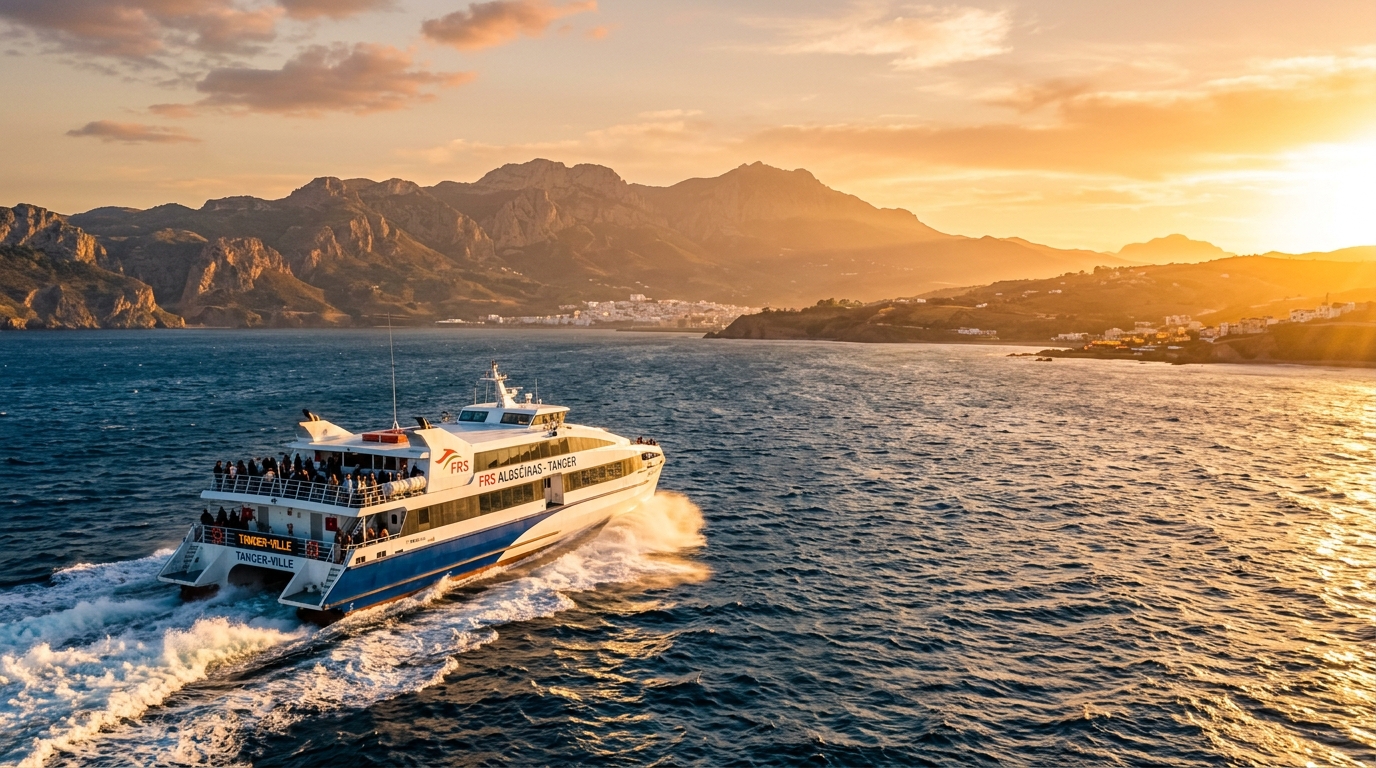
There are few international border crossings on Earth as romantic and visually dramatic as sailing across the Strait of Gibraltar. In just 60 minutes, the European continent dissolves into sea spray, and the jagged, sun-drenched peaks of the Moroccan Rif mountains rise on the horizon. You depart the whitewashed windsurfing capital of Tarifa in Andalusia and step ashore in the storied international port of Tangier, North Africa.
Yet, for all its historic romance, crossing from Spain to Morocco by ferry is fraught with logistical pitfalls for first-timers: boarding the wrong ferry that drops you at an industrial container port 50 kilometers away from civilization, missing the mandatory on-board passport inspection booth, falling victim to aggressive port taxi touts, or discovering too late that your European rental car cannot legally cross the maritime border.
Whether you are embarking on a grand 14-day Spain and Morocco overland expedition or using southern Spain as a springboard into northern Morocco, this definitive 2026 field guide provides every detail necessary for a seamless, stress-free strait crossing.
⚡ Quick Verdict: Which Spain to Morocco Ferry Route Should You Book?
The only route tourists should book. Fast catamaran takes exactly 60 minutes and drops you right in downtown Tangier medina. Walkable to boutique riads and waterfront cafés.
Huge roll-on/roll-off ferries. Takes 90–120 minutes and docks at the commercial Tanger Med port, 50 km (50 mins drive) east of Tangier. Unsuitable for casual foot passengers.
Multi-day voyages (28–32 hours) with private cabins. Practical only for long-distance European road-trippers transporting specialized overland expedition rigs.
1. The Two Main Routes: Tarifa vs Algeciras (Don't Make This Mistake!)
The single most catastrophic error international travelers make is confusing Tangier Ville (Tanger Ville) with Tanger Med. They are two completely different ports separated by 50 kilometers of winding highway:
- Route A: Tarifa to Tangier Ville (FRS / DFDS & Baleària):
This is the gold standard for travelers. Tarifa is the southernmost tip of continental Europe. High-speed catamarans cover the 14-kilometer strait in 60 minutes flat. You arrive directly at Tangier Ville port, located immediately beneath the ancient walls of the Kasbah and Medina. - Route B: Algeciras to Tanger Med (FRS, Baleària, AML, Trasmediterránea):
Algeciras is an industrial Spanish port city. Ferries here are large vehicle vessels that dock at Tanger Med, a sprawling commercial container terminal nestled near Ksar Sghir. If you arrive here as a foot passenger without pre-arranged transport, you face an exhausting, expensive 50-minute taxi ride just to reach Tangier city.
2. Spain to Morocco Ferry Comparison Matrix (2026)
| Route | Crossing Time | Daily Sailings | Arrival Port Location | One-Way Foot Fare | Best For |
|---|---|---|---|---|---|
| Tarifa → Tangier Ville | 60 Minutes | Every 2 Hours (7:00 AM – 9:00 PM) | Downtown Tangier Medina | €38 – €45 | All tourists & foot passengers |
| Algeciras → Tanger Med | 90 – 120 Mins | Continuous (Hourly) | 50 km East of Tangier | €32 – €40 | Freight, trucks & personal cars |
| Algeciras → Ceuta | 60 Minutes | Hourly | Spanish Enclave of Ceuta | €30 – €38 | Border land-crossing to Tetouan |
| Gibraltar → Tangier Med | 90 Minutes | Seasonal / Very Limited | 50 km East of Tangier | €45 – €55 | Specialized charters |
3. The Secret On-Board Border Control Rule (Crucial Tip!)
Nearly every first-time traveler expects Moroccan border police to check passports in a booth at the arrival terminal after disembarking. This is NOT how the Tarifa-to-Tangier ferry operates!
On the Tarifa → Tangier Ville ferry, Moroccan passport control takes place inside the vessel while the ship is sailing across the strait.
- As soon as you board the catamaran in Tarifa, pick up a white Fiche de Débarquement (entry slip) from the counter and fill out your details (name, passport number, hotel address in Morocco).
- Locate the Moroccan police booth situated inside the main passenger cabin (usually near the duty-free shop or cafeteria).
- Stand in line immediately. The officer inspects your passport, verifies your entry card, and stamps your passport with your unique Moroccan national entry number (N° d'Immatriculation).
- If you do not get this stamp before the ferry docks, you will not be allowed to exit the port gate in Tangier and will be sent back onto the ship or held until the next sailing's police officer arrives!
4. Can You Bring a European Rental Car into Morocco?
A frequent inquiry from self-drive road-trippers exploring Andalusia is: "Can I drive my Spanish rental car onto the ferry to explore Chefchaouen and Fes?"
The short answer is: Almost never.
Major rental car agencies in Spain (Hertz, Avis, Europcar, Sixt, Enterprise) strictly forbid taking their vehicles outside the European Union. Their insurance coverage terminates the moment the car rolls onto the ferry. Furthermore, taking a car through Moroccan customs at Tanger Med requires temporary import permits (D16 ter form) that require the driver to be the legal owner listed on the vehicle registration (Permiso de Circulación).
The Sensible Solution: Park your Spanish rental car in the secure multi-story parking garage at the Port of Tarifa (approx. €16–€20/day) or drop it off in Seville/Málaga and take a comfortable bus to Tarifa. Then, book a dedicated private driver with an air-conditioned luxury vehicle to meet you at the port in Tangier.
5. The Tangier Port Arrival: Private Chauffeur Handoff
Arriving at Tangier Ville port is an exhilarating sensory experience. However, walking out through the port security exit into the arrivals plaza can be intimidating: independent taxi touts swarm arriving passengers, aggressively shouting "Taxi, mister! Chefchaouen, very cheap!".
Local city taxis (Petits Taxis, which are light blue in Tangier) are legally forbidden from leaving the municipal city limits. If you attempt to hire an unvetted rural taxi (Grand Taxi) at the port, you will often find yourself crammed into an aging, non-air-conditioned vehicle with luggage tied to the roof rack.
Seamless Tangier Port Chauffeur Service by Roam Morocco
Eliminate all stress from the moment you step foot on African soil. When you book a private circuit or chauffeur transfer with Roam Morocco:
- Live Ferry Monitoring: Your driver monitors your vessel's departure from Tarifa. Even if winds cause departure delays in Spain, your driver is waiting at the exact moment you clear customs.
- Personalized Welcome: Your professional, English-speaking Moroccan driver meets you immediately outside the glass customs exit doors holding a personalized Roam Morocco welcome tablet with your name.
- Executive Fleet: Luggage is handled with care into a pristine, climate-controlled Mercedes V-Class or Toyota Prado 4x4.
- Direct Onward Journey: Relax with cold bottled water and onboard Wi-Fi as you drive 2 hours directly into the blue mountain medina of Chefchaouen, or commence your customized 8-to-12 day expedition toward Fes, the Sahara dunes, and Marrakech.
6. Mobile Data Alert: The Strait of Gibraltar Roaming Trap
Within the European Union, travelers enjoy free EU "Roam Like at Home" on their European SIM cards. However, Morocco is NOT in the European Union.
The second your ferry approaches the Moroccan coastline, your smartphone will switch from Spanish cell towers (Movistar/Vodafone) to Moroccan carriers (Maroc Telecom, inwi, or Orange). Standard international carrier roaming rates in Morocco are exorbitant—frequently costing $10 per megabyte or $15/day for sluggish data caps.
- Set Up Before Sailing: Download an Airalo Choukran Morocco eSIM while connected to Wi-Fi at your hotel in Spain.
- Instant 4G/5G Connectivity: Activate the eSIM line as soon as you dock in Tangier Ville port. Message your driver, check hotel bookings, and navigate WhatsApp instantly without hunting for SIM card kiosks.
- Fair Transparent Rates: 1 GB starting at $8.00 USD, 5 GB for $24.00 USD.
7. How to Reach the Port of Tarifa from Spain
Tarifa is a bohemian, whitewashed Andalusian seaside town on the Costa de la Luz. Depending on where your Spanish journey begins, here is how to get there:
- From Seville (2.5 hours): Transportes Comes operates direct daily air-conditioned express buses from Seville (Prado de San Sebastián station) directly to Tarifa bus terminal, located 10 minutes walk from the ferry port.
- From Málaga / Costa del Sol (2 hours): Avanza buses run from Málaga Maria Zambrano station to Algeciras. From Algeciras, FRS ferry lines provide a free shuttle bus connecting Algeciras port to Tarifa port for passengers holding valid FRS ferry tickets.
- From Algeciras Train Station (Renfe): If taking the scenic Renfe train from Madrid or Ronda down to Algeciras, take a 10-minute taxi to Algeciras port and board the complimentary FRS ferry shuttle bus to Tarifa.
"Standing on the open observation deck of the catamaran as the coast of Spain recedes and the white medina ramparts of Tangier emerge from the morning mist is one of the most unforgettable travel memories on Earth. In one single hour, you transition between worlds."
8. Frequently Asked Questions About the Spain-to-Morocco Ferry
How long does the ferry from Spain to Morocco take?
The high-speed passenger catamaran from Tarifa to Tangier Ville takes exactly 60 minutes across the water. The conventional ferry from Algeciras to Tanger Med takes between 90 and 120 minutes.
What happens if the ferry is cancelled due to high winds (Levante)?
The Strait of Gibraltar is prone to fierce easterly winds known as the Levante. When winds exceed safety thresholds, the Port of Tarifa may suspend fast catamaran sailings. In this rare event, ferry companies automatically transfer passengers onto large roll-on/roll-off vehicle vessels departing from the protected harbor of Algeciras to Tanger Med. Our private chauffeur dispatch automatically adjusts pickup logistics to meet you at Tanger Med at no extra inconvenience.
Do I need a visa to take the ferry to Morocco?
Citizens of the United States, Canada, United Kingdom, Australia, New Zealand, and European Union nations do not need a visa for tourist visits to Morocco for stays up to 90 days. You only need a valid passport with at least 6 months validity remaining.
How much luggage can I bring on the ferry?
Unlike airlines, ferry operators (FRS and Baleària) do not weigh or limit standard passenger luggage. Foot passengers are allowed to bring large suitcases, rolling bags, backpacks, and personal items free of charge. You carry your bags onto the vessel and store them in luggage racks in the passenger lounge.
Can I exchange currency or get Moroccan Dirhams at Tangier port?
Yes. The passenger arrival terminal at Tangier Ville port features multiple bank currency exchange windows and bank ATMs (distributeurs de billets) where you can withdraw Moroccan Dirhams (MAD) using international debit cards. We recommend withdrawing 500 to 1,000 MAD for small tips and snacks before starting your overland drive.