
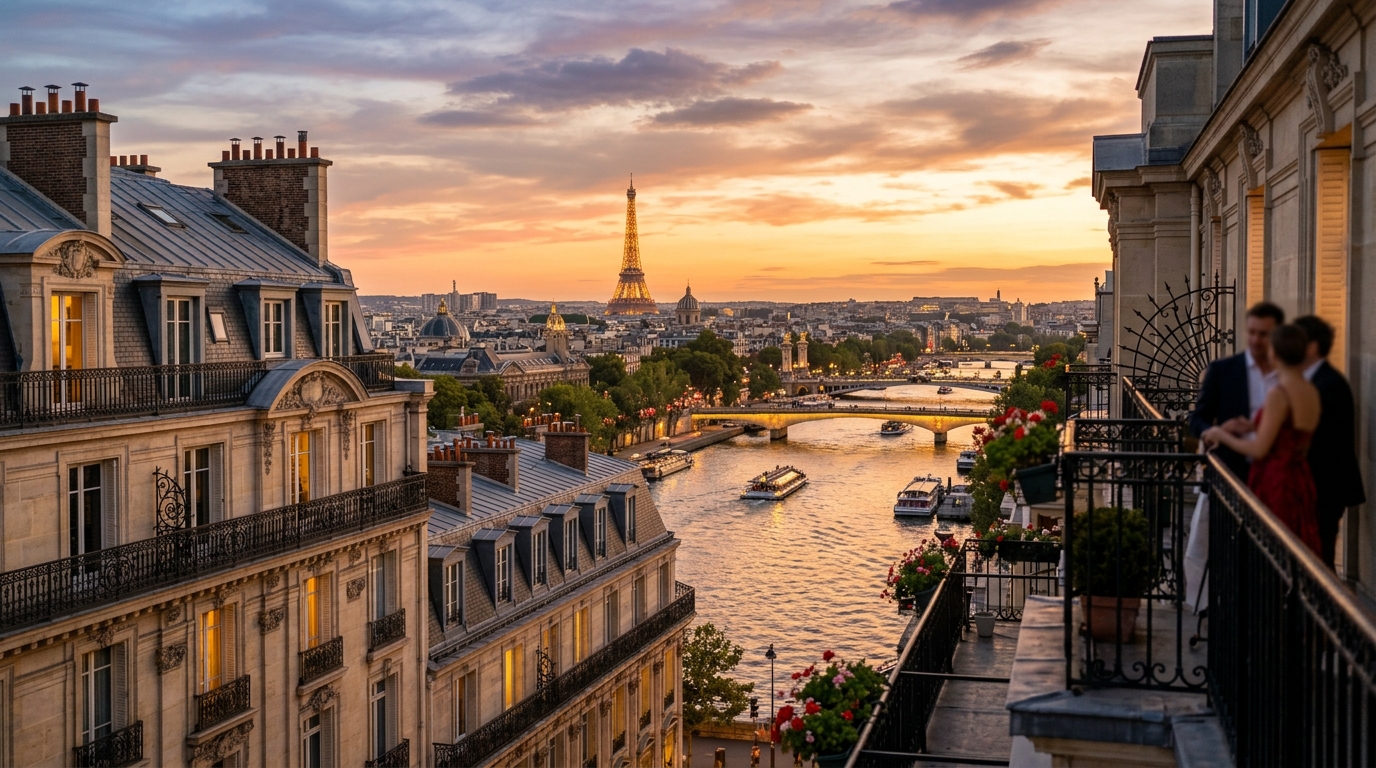
Deciding where to stay in Paris can feel deceptively straightforward until you open a map. Unlike compact grid cities like Manhattan or Barcelona, the French capital is an intricate spiral of 20 numbered administrative districts (arrondissements), coiled outward like a snail shell (l’escargot) along both banks of the winding Seine River.
Pick the wrong arrondissement, and you will spend forty minutes every morning trapped in stifling underground Metro interchanges or dealing with rowdy nightlife below your window when all you wanted was quiet coffee on a wrought-iron balcony. Pick the right base, however, and Paris unfolds effortlessly: fresh croissants from a neighborhood boulangerie around the corner, romantic evening strolls along the riverbanks, and iconic monuments reachable within a pleasant fifteen-minute walk.
Whether you are planning a high-energy first-time itinerary, a romantic anniversary escape, or using Paris as a glamorous European prelude to your expedition across Morocco, this comprehensive 2026 guide breaks down the nuances of each premier neighborhood, curated hotel addresses, and airport transit logistics.
⚡ Quick Verdict: Where to Stay in Paris by Travel Style
Medieval pedestrian streets, chic designer boutiques, world-class bakeries, and immediate walking proximity to Notre-Dame, the Seine, and the Louvre.
Aristocratic Left Bank elegance, Luxembourg Gardens, storied literary cafés (Café de Flore, Les Deux Magots), and peerless safety.
Quiet residential charm, postcard iron tower backdrops, the gourmet market street Rue Cler, and Musée d'Orsay.
Canal Saint-Martin and Oberkampf. Home to Paris's best natural wine bars, cutting-edge bistronomy, and a vibrant local scene free of mass tourist traps.
1. Understanding the Parisian "Escargot": Left Bank vs Right Bank
Before selecting a hotel, every traveler must grasp the fundamental divide that has defined Parisian culture for a millennium: The Seine River, which cleaves the city into the Right Bank (Rive Droite) to the north and the Left Bank (Rive Gauche) to the south.
- The Right Bank (Rive Droite): The historic domain of commerce, high finance, theater, luxury shopping, and royal palaces. Arrondissements include the 1st (Louvre), 2nd (Bourse), 3rd & 4th (Le Marais), 8th (Champs-Élysées), 9th (Opéra Garnier), and the trendy 10th/11th. It is energetic, vibrant, trendsetting, and dense with dining and shopping.
- The Left Bank (Rive Gauche): The intellectual and bohemian heart of Paris, dominated by university academies (Sorbonne), historic publishing houses, artist studios, and aristocratic private mansions (hôtels particuliers). Arrondissements include the 5th (Latin Quarter), 6th (Saint-Germain), and 7th (Eiffel Tower). It is quieter, more romantic, exceptionally safe, and quintessential "old-world" Paris.
2. The Best Arrondissements to Stay in Paris (Head-to-Head)
1. Le Marais (3rd & 4th Arrondissements)
Spared from Baron Haussmann’s sweeping 19th-century demolitions, Le Marais is one of the very few neighborhoods in Paris where you can still wander through narrow, cobblestone medieval alleyways lined with 17th-century aristocratic courtyards. Today, it stands as the pulsing cultural nexus of the capital, brimming with designer showrooms, third-wave coffee roasters, contemporary art galleries, and the historic Jewish and LGBTQ+ quarters.
Why It’s Perfect for First-Timers: You can step out of your boutique hotel and walk to the Louvre, Centre Pompidou, Notre-Dame Cathedral on Île de la Cité, and the majestic Place des Vosges in 10 to 15 minutes. Even late at night, the streets feel bustling, safe, and delightfully social.
The Only Drawback: Because of the medieval preservation, hotel rooms here are notoriously intimate, and historic buildings frequently lack elevators. Book well in advance to secure rooms on lower floors if stairs are a concern.
Curated Hotel Picks in Le Marais:
2. Saint-Germain-des-Prés (6th Arrondissement)
If you close your eyes and picture the archetypal cinematic Paris—emerald-canopied sidewalk bistros where Jean-Paul Sartre and Simone de Beauvoir debated philosophy, polished limestone façades, and antique print shops—you are imagining Saint-Germain-des-Prés. Centered around Paris’s oldest standing Romanesque church (Église Saint-Germain), this neighborhood radiates an effortless, cultured luxury.
Highlights & Atmosphere: Saint-Germain borders the Jardin du Luxembourg, arguably the most enchanting public park in Europe, where you can read beside the Medici Fountain or watch children sail wooden boats on the grand basin. Dining here ranges from iconic historic brasseries like Brasserie Lipp to Michelin-starred dining on Rue du Pré-aux-Clercs.
Best For: Couples, honeymooners, and travelers who appreciate peaceful evenings, impeccable security, and classic Parisian refinement over late-night rowdiness.
Curated Hotel Picks in Saint-Germain:
3. 7th Arrondissement (Eiffel Tower & Invalides)
Home to foreign embassies, government ministries, and the Iron Lady herself, the 7th Arrondissement represents the height of French aristocratic prestige. Broad tree-shaded avenues provide dramatic, sudden glimpses of the Eiffel Tower rising above Haussmannian slate rooftops.
The Local Vibe: Despite housing the most famous monument on Earth, the residential streets behind Champ-de-Mars feel surprisingly village-like. The pedestrianized Rue Cler is widely regarded as Paris's finest open-air market street, lined with generational fromageries, rotisseries, florist stalls, and specialty wine purveyors.
Pro Tip: To avoid feeling isolated from the historic center, choose a hotel on the eastern side of the 7th (closer to Metro Rue du Bac or Musée d'Orsay), which allows you to walk to Saint-Germain and the Louvre within 10 to 15 minutes.
Curated Hotel Picks in the 7th:
4. 1st Arrondissement (Louvre, Tuileries & Palais-Royal)
The 1st Arrondissement is the geographic center of Paris (Kilometre Zero). It is an imperial showcase of manicured majesty: the arcades of Rue de Rivoli, the sculpture gardens of Palais-Royal, the Tuileries Gardens, and the gargantuan Musée du Louvre. If you choose to stay here, you practically never need to take the Metro; almost every signature attraction is accessible on foot.
The Tradeoff: Because it is the historical ground-zero for international tourism, the 1st has fewer authentic residential neighborhood grocery stores and higher restaurant price premiums. However, for a whirlwind 3 or 4-day city break where time is your most precious asset, the sheer efficiency is unbeatable.
Curated Hotel Picks in the 1st:
5. 10th & 11th Arrondissements (Canal Saint-Martin & Oberkampf)
If you want to experience where modern Parisians actually eat, drink, and socialize away from tour buses, head northeast to the 10th and 11th. Centered around the serene, iron-footbridged waterways of Canal Saint-Martin and the bustling avenues of Oberkampf, this is the global epicenter of Paris's famous bistronomie movement—where young, Michelin-trained chefs opened casual, affordable dining temples serving unpretentious farm-to-table menus.
Value Proposition: Hotel rates here are typically 25% to 40% lower than in Saint-Germain or Le Marais, allowing you to stretch your budget toward better rooms or memorable tasting menus. Excellent Metro connectivity (Lines 3, 5, 8, 9, 11) gets you to the Louvre or Opéra in 12 minutes.
Curated Hotel Picks in the 10th & 11th:
6. Montmartre (18th Arrondissement - Upper Village)
Perched high above the city on its famous northern hill (la butte), Montmartre was once an independent rural village outside the city walls, favored by painters like Renoir, Picasso, and Van Gogh for cheap wine and panoramic sky views. While the immediate square in front of Sacré-Cœur is crowded with caricature artists, the quiet back streets behind the basilica (around Rue Cortot, Rue Lepic, and Metro Lamarck-Caulaincourt) preserve an intoxicating vintage romance.
Important Caution: Montmartre requires serious stair climbing and hill walking. It also sits further north of the major museums (allow 25 minutes by Metro to the Louvre or Eiffel Tower). Avoid the boulevard directly along Boulevard de Clichy/Pigalle if you dislike noisy adult shops and nightlife traffic.
Curated Hotel Picks in Montmartre:
3. Paris Arrondissement Comparison Matrix (2026)
Use this side-by-side guide to evaluate walkability, safety, average nightly hotel costs, and nearby highlights across the top six districts:
| Arrondissement | Prime Neighborhood Vibe | Walkability Score | Avg Rate / Night | Nearest Iconic Landmark | Key Metro Line |
|---|---|---|---|---|---|
| 4th (Le Marais) | Medieval alleys, boutiques & dining | 10 / 10 | €220 – €480 | Place des Vosges & Notre-Dame | Line 1, Line 4 |
| 6th (Saint-Germain) | Intellectual luxury & quiet romance | 9.5 / 10 | €250 – €550 | Luxembourg Gardens | Line 4, Line 10 |
| 7th (Eiffel / Invalides) | Prestigious residential & market streets | 8.5 / 10 | €230 – €500 | Eiffel Tower & Musée d'Orsay | Line 8, Line 12, RER C |
| 1st (Louvre) | Monumental grandeur & royal gardens | 10 / 10 | €300 – €650 | Musée du Louvre & Tuileries | Line 1, Line 7, Line 14 |
| 10th & 11th (Canal) | Hipster bistronomy & natural wine | 8.0 / 10 | €150 – €280 | Canal Saint-Martin | Line 3, Line 5, Line 9 |
| 18th (Montmartre) | Bohemian cobblestone village & views | 7.0 / 10 | €140 – €260 | Sacré-Cœur Basilica | Line 2, Line 12 |
4. The Perfect 4-Day First-Timer Paris Itinerary
Maximizing Paris comes down to pacing. Too many visitors exhaust themselves running crisscross across the city. By clustering your explorations by bank and neighborhood, you spend more time sipping espresso in sunlight and less time underground.
DAY 01 The Medieval Cradle & Royal Grandeur
Morning: Start at the historical birthplace of Paris on Île de la Cité. Admire the newly restored façade and spire of Notre-Dame Cathedral, then walk two blocks to gasp at the jaw-dropping 13th-century stained glass inside Sainte-Chapelle (reserve early morning timed-entry tickets).
Afternoon: Cross the Pont Neuf into the 1st Arrondissement. Wander through the quiet, columned arcades of Palais-Royal before strolling the manicured gravel paths of Tuileries Gardens.
Evening: Enter the Musée du Louvre for an evening visit (open until 9:45 PM on Wednesdays and Fridays for fewer crowds). Watch the glass pyramid illuminate against the twilight sky.
DAY 02 Left Bank Romance & Impressionist Masterpieces
Morning: Breakfast at a traditional sidewalk table on Boulevard Saint-Germain, followed by a stroll through the Luxembourg Gardens. Watch local chess masters compete under the chestnut trees.
Afternoon: Visit the magnificent Musée d'Orsay in the 7th Arrondissement, housed inside an opulent 1900 Beaux-Arts railway station, to admire Monet, Van Gogh, Degas, and Cézanne.
Evening: Walk through Champ-de-Mars to picnic or view the Eiffel Tower at sunset. Stay to watch the five-minute sparkling light illumination that occurs on the hour every evening after dusk.
DAY 03 Bohemian Montmartre & Canal Saint-Martin Sunset
Morning: Take Metro Line 12 up to Lamarck-Caulaincourt. Climb the quiet rear steps of Montmartre to reach Sacré-Cœur Basilica before the tour buses arrive. Wander down picturesque Rue de l’Abreuvoir past La Maison Rose.
Afternoon: Ride Metro Line 2 over to Canal Saint-Martin in the 10th Arrondissement. Browse indie bookshops, sip artisanal espresso at Ten Belles, and watch boats pass through the historic iron locks.
Evening: Settle in for dinner at a relaxed neo-bistro in the 11th Arrondissement (such as Clamato or Le Chateaubriand) pairing seasonal small plates with biodynamic French wines.
DAY 04 Le Marais Hidden Courtyards & Seine Cruise
Morning: Explore the boutique maze of Le Marais. Pick up fresh pastries from Du Pain et des Idées or Poilâne, then sit under the 17th-century arcades at Place des Vosges, the oldest planned square in Paris.
Afternoon: Browse the contemporary exhibitions at the Centre Pompidou or the Picasso Museum, followed by falafel on Rue des Rosiers.
Evening: Conclude your stay with an unhurried sunset cruise along the Seine (Vedettes du Pont Neuf), watching the golden limestone monuments drift by under Paris's romantic historic bridges.
5. Paris Airport Transit Hacks (CDG & ORY into the City)
Arriving in Paris can be seamless or intensely frustrating depending on how well you prepare for airport transit. The city is served by two main international airports:
Charles de Gaulle Airport (CDG) — 25 km Northeast
- RER B Train (Fastest & Most Cost-Effective): Connects directly from CDG Terminal 2 and Terminal 1/3 to Gare du Nord, Châtelet-Les Halles, and Saint-Michel in 35–45 minutes. Cost is €11.80 one-way. Best for solo travelers and light packers.
- Official Flat-Rate Taxis (Best for Luggage & Groups): By French law, official taxis operating from airport ranks charge fixed, non-negotiable flat rates: €56 to the Right Bank and €65 to the Left Bank.
- ⚠️ Scammer Warning: Never follow anyone inside the arrival terminal offering "taxi service" or "private car." Always walk directly outside to the designated official taxi queue staffed by uniformed dispatchers. Unauthorized drivers routinely scam unsuspecting tourists for €150–€200.
Paris Orly Airport (ORY) — 13 km South (The 2026 Transit Revolution)
Historically considered less convenient by public transit, Orly underwent a massive upgrade with the Metro Line 14 southern extension. Today, you can step off your flight at Orly and ride the driverless Metro Line 14 directly into Châtelet or Gare de Lyon in just 25 minutes for €10.30. It is faster, cleaner, and more reliable than any airport train in Europe.
Prefer a dedicated driver waiting with a personalized name card inside arrivals, 60 minutes free wait time, flight delay tracking, and luggage assistance directly to your hotel doorstep? Pre-book a verified flat-rate private transfer:
6. Staying Connected: The 2026 France & Europe eSIM Guide
Navigating the Paris Metro network, checking opening hours at the Louvre, booking restaurant reservations, and calling Ubers requires constant, reliable mobile data. Waiting in line at airport kiosks after a 9-hour transatlantic flight to buy a physical plastic SIM card is an outdated, stressful hassle.
In 2026, over 80% of savvy international travelers use an instant eSIM. Airalo offers the Mamezi France and Eurolink Regional packages that download directly to your smartphone via QR code before departure.
- Instant Activation: Connects to Orange or Bouygues Telecom 5G the exact second your plane touches down at CDG or ORY.
- Keep Your WhatsApp & Number: Your home carrier SIM remains active for 2-factor authentication texts while all mobile data runs via the high-speed local French profile.
- Budget-Friendly: 1 GB starting at $4.50, up to 20 GB for $36 (a fraction of US carrier $10/day international roaming add-ons).
7. The Trans-Mediterranean Bridge: Combining Paris & Morocco
For centuries, Paris has served as the romantic western gateway to North Africa and the Orient. Because of deep historical ties and high aviation frequency, Paris is the single easiest European hub from which to fly directly into Morocco.
From the Seine to the Sahara in 3 Hours
Daily direct flights depart from both Paris Charles de Gaulle (CDG) and Paris Orly (ORY) directly into Marrakech Menara (RAK) and Casablanca Mohammed V (CMN) on Royal Air Maroc, Air France, and Transavia. In just 3 hours and 10 minutes, you can transition from an afternoon espresso on the Left Bank to sipping fresh mint tea on a candlelit riad terrace in Marrakech.
Many of our guests combine a 4-day cosmopolitan Paris vacation with a private 7 to 10-day chauffeured tour across the Atlas Mountains and Erg Chebbi desert dunes with Roam Morocco.
Design Your Custom Morocco Tour →"There is something profoundly exhilarating about having breakfast on a Haussmannian balcony in Paris, boarding an 11:00 AM flight at Orly, and arriving in Marrakech in time to watch the sun set over the Koutoubia Mosque while the scent of cedar and spices fills the medina air."
8. Frequently Asked Questions About Staying in Paris
Where is the safest area to stay in Paris?
Paris is generally a very safe global metropolis, but the 6th Arrondissement (Saint-Germain), 7th Arrondissement (Eiffel/Invalides), and 16th Arrondissement (Passy/Trocadéro) are among the safest, wealthiest residential neighborhoods in Europe. Violent crime is rare across central Paris; pickpocketing in crowded Metro stations and tourist clusters (around the Eiffel Tower, Sacré-Cœur, and Gare du Nord) is the primary safety concern.
How much does a hotel in central Paris cost in 2026?
On average for central arrondissements (1st–8th): clean 3-star boutique hotels range between €160 and €260 per night; charming 4-star boutique hotels range between €280 and €450 per night; while 5-star palace hotels (like Le Meurice, Hôtel de Crillon, or Plaza Athénée) typically start at €1,100+ per night. For better value, look at high-design hotels in the 10th and 11th arrondissements (€140–€220/night).
How many days are ideal for a first-time trip to Paris?
We recommend a minimum of 4 to 5 full days. This provides sufficient breathing room to see major landmarks (Louvre, Eiffel Tower, Notre-Dame, Orsay) without rushing, while leaving unstructured afternoons to enjoy sidewalk café culture, boutique shopping, and garden strolls.
Is it necessary to speak French to stay in Paris?
No, English is widely spoken in hotels, restaurants, shops, and transport hubs. However, the cultural ritual of greeting is critical: always begin any interaction with a warm "Bonjour, Madame/Monsieur" before asking a question or ordering. This simple courtesy dramatically transforms your customer service experience across France.
How do I travel from Paris to Morocco?
Multiple airlines operate direct, nonstop flights between Paris (CDG and ORY) and Morocco (Marrakech RAK, Casablanca CMN, Fes FEZ, and Tangier TNG). Flight duration is approximately 3 hours and 10 minutes. Transavia, Air France, and Royal Air Maroc run several flights daily, with one-way fares often available from €60 to €180 depending on the season.